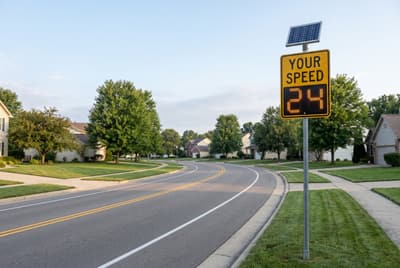
A radar speed sign — also called a driver-feedback or "Your Speed" sign — reads each approaching vehicle with Doppler radar and shows the driver their own speed on a bright LED display. It's one of the most effective traffic-calming tools there is: no ticket, no enforcement, just immediate feedback that gets most drivers to ease off. This guide covers the device tiers (from a $900 flashing speed-limit sign to a full radar system), how to size the display to the road, the power options, and the data features that turn a sign into a before-and-after speed study.
Pick the right device tier
Speed management is a ladder. Start with the cheapest device that actually addresses the complaint — a flashing speed-limit sign is a fine gateway, but it can't tell you (or the driver) how fast anyone is going. A radar feedback sign does, and a full-matrix or enforcement device escalates from there.
What's the goal?
Start with a Radar "Your Speed" feedback sign (≈$2,700–$8,000) — Doppler radar reads each vehicle's speed and shows it back on a big LED display, with a strobe for violators. Shop it →
| Tier | What it is | Catalog price band | Reach for it when |
|---|---|---|---|
| Flashing speed-limit sign | A solar MUTCD speed-limit sign with built-in flashing LEDs — posts and flashes the limit, no radar. | ≈$900 | You just need the posted limit to stand out (a school zone or gateway), not to measure each driver's speed. |
| Radar "Your Speed" feedback sign | Doppler radar reads each vehicle's speed and shows it back on a big LED display, with a strobe for violators. | ≈$2,700–$8,000 | Speeding complaints on a street, campus or HOA road — showing drivers their own speed is the classic calming move. |
| Full-matrix (FM) message sign | A feedback display that also shows programmable messages — "SLOW DOWN", a smiley/frown, or custom text. | ≈$3,200–$5,300 | You want the display to coach as well as measure, or to double as a small changeable-message sign. |
| Variable speed-limit / enforcement | A driver-feedback sign with a changeable posted limit (SP550), or a radar enforcement camera that captures violators. | ≈$4,300–$16,000 | Variable limits on a corridor, or you need documented enforcement rather than voluntary compliance. |
Price bands are catalog-wide, rounded, and span the size and power options within each tier — see each product page for live pricing. The flashing speed-limit signs come in 5–35 MPH; the radar feedback signs are the SPEED RADAR SIGNS collection.
How a driver-feedback sign works
Every radar feedback sign does the same three things: a K-band Doppler radar (around 24.1 GHz) measures the speed of the nearest approaching vehicle, an LED display shows that number back — usually under a fixed "YOUR SPEED" legend — and a speed-violator strobe flashes when a driver is over a threshold you program. An ambient light sensor dims the display at night so it's readable without glare. The whole unit is weather-sealed and, in the solar models, entirely self-powered.
Sizing the display to the road
The key spec is how far out a driver can read the number: bigger digits and brighter LEDs are legible from farther away, which matters more the faster the approach. Match the rated legibility distance to the approach speed so a driver sees their speed with time to react. Here's how the range lines up across the catalog:
| Model | Display | Legibility | Power |
|---|---|---|---|
| 11" Your Speed | 11″ two-digit | Up to ~1,000 m | 120 W bifacial solar + 36 Ah lithium |
| SP100 | 11″ two-digit | Up to ~300 ft | Solar (20 W/50 W) or AC |
| EV11 / EV12 / EV15 | Two-digit, 200+ LEDs | Long-range, high-brightness | Solar (20 W/50 W), cloud-connected |
| SP550 variable limit | Speed + changeable limit | Up to ~1,200 ft | Solar (50 W) or 100–240 V AC |
| SP700 | Full matrix, 1,300+ LEDs | Highway-scale | 140 W solar |
Legibility figures are the manufacturers' rated distances and vary with weather, sun angle and mounting height — treat them as relative, and step up a size when the approach is fast or the sight line is long. The EV18-FM and SP700 are the largest, highway-scale displays.
Power & mounting
Power is usually the first real decision. Most models are solar (20 W panels on the compact SP/EV signs up to 140 W on the big SP700, and a 120 W bifacial panel on the 11″ Your Speed sign), and several also offer AC — the SP550 takes 100–240 V AC or a 50 W solar panel. Batteries range from a 12 V / 18 Ah pack on the SP/EV line to a 36 Ah lithium on the Your Speed sign, giving 1–5 days of autonomy (24-hour continuous on the Your Speed). Everything mounts on a 3″ round pole; add the universal radar mounting bracket for other poles, or the radar speed sign dolly to redeploy a sign around town without pouring a foundation.
Data & smart features
Beyond the live display, the value of a radar sign is the data. The EV series ships with a year of cloud connectivity, and the signs log the speeds they measure — so you can pull a before-and-after study to prove a calming program worked, set the violator-strobe threshold to your posted limit, and let the auto-brightness handle day-to-night readability. Speed reads out in MPH or KM/H, typically to within ±1 MPH. When you need documented enforcement rather than voluntary compliance, the Guardian Pro speed radar camera captures violators instead of only showing them their speed.
Spec tip
Deciding between a fixed pole-mounted sign and a portable one? A dolly-mounted radar sign lets an HOA or town rotate one unit between problem streets and collect a week of data at each — often a better first buy than a permanent install. Send us the road, the posted speed and the power situation and we'll spec the model.
Common questions
Do radar speed signs actually slow traffic down?
Showing drivers their own speed is a well-established traffic-calming measure — most drivers ease off when the number lights up, especially with a violator strobe. Effectiveness depends on siting and whether you follow up with the logged data, which is why the signs record the speeds they measure.
Solar or AC power?
Solar is the default and needs no wiring — ideal where you can't run AC. If you have power at the pole and want zero dependence on sun (a shaded corridor, a variable-limit sign that runs a heavier display), choose a model with an AC option such as the SP550.
What digit size do I need?
Match legibility distance to approach speed. An 11″ two-digit display suits most residential and collector streets; step up to a larger full-matrix display (EV18-FM, SP700) for higher-speed or wider roads where drivers need to read it from farther out.
What's the difference between a feedback sign and a speed camera?
A driver-feedback sign shows a driver their speed to encourage voluntary compliance — no citation. An enforcement camera like the Guardian Pro captures violations for documentation or ticketing. Many agencies start with feedback signs and reserve cameras for persistent problem spots.
Can the sign show a message, not just a number?
The full-matrix "FM" models (EV12-FM, EV15-FM, EV18-FM) can display programmable text and symbols — "SLOW DOWN", a frown/smiley, or custom messages — in addition to the measured speed.
Shop radar speed signs
- Speed Radar Signs — the full driver-feedback range
- 11″ "Your Speed" Radar Sign — the classic entry model, $2,700
- SP100 Radar Speed Sign — solar or AC, $2,975+
- SP550 Variable Speed-Limit Sign — feedback + changeable posted limit
- Solar Flashing Speed-Limit Signs — 5–35 MPH, $900
- Speed Management & Driver Feedback — the whole calming toolkit
Speccing a corridor, campus or district-wide program? The companion guide to choosing solar flashing, school-zone & radar speed signs shows how radar fits the broader active-warning ladder, and the solar flashing beacon guide covers the beacons that often go with it. Ready for a quote? Contact us with your locations, posted speeds and quantities.