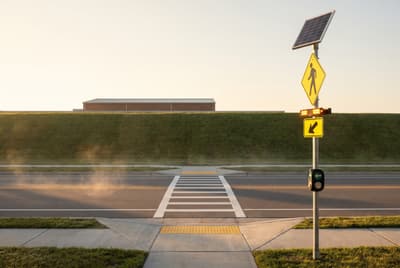
Our signature line is active warning — 150+ products spanning school-zone signs, solar flashing LED signs, beacons, push-button crosswalk systems and radar displays, from a $30 qualifier plaque to the push-button crosswalk system on our home page. The flashing units are self-powered: no trenching, no electrician, no power bill. This guide walks the four escalation tiers, the school-zone sign set, sizing, and the power and activation options — so you spec the right level of “active” the first time.
Pick your escalation tier
Traffic calming is a ladder: each step up buys more driver attention and costs more. Start at the cheapest tier that plausibly solves the problem — an under-used push-button system is an expensive way to do a static sign's job.
What's the situation?
Start with Solar flashing signs & beacons (≈$700–$1,700) — The MUTCD sign plus built-in LEDs, solar panel and battery — self-contained, no trenching or AC run. Shop the tier →
| Tier | What you get | Catalog price band | Reach for it when |
|---|---|---|---|
| Static MUTCD signs | Aluminum sign on your choice of reflective sheeting (Engineer Grade, High Intensity Prismatic or Diamond Grade). | ≈$20–$210 | Marking a zone, route or crossing where a passive sign is enough — or completing a school-zone set around a flashing unit. |
| Solar flashing signs & beacons | The MUTCD sign plus built-in LEDs, solar panel and battery — self-contained, no trenching or AC run. | ≈$700–$1,700 | Drivers are missing the static sign — the flash buys back attention at a crossing, stop, curve or school-zone entrance. |
| Push-button & RRFB systems | Pedestrian-actuated: a push button triggers flashing signs or rapid-flashing beacon bars, in 2-, 3- or 4-sign configurations. | ≈$1,250–$7,600 | An uncontrolled crosswalk where the flash should fire only when someone is actually waiting to cross. |
| Radar driver-feedback signs | Radar unit plus an LED “YOUR SPEED” display; solar, AC or swappable-battery powered. | ≈$2,700–$8,000 | Speeding complaints on a street, campus or HOA road — showing drivers their own speed is the classic calming move. |
Price bands are catalog-wide, rounded, and span size and option choices — see each product page for live pricing. Where each device type is allowed (RRFBs, in-street signs, flashing speed limits) is set by the MUTCD and your state supplement — verify placement with your state or local traffic authority.
The school-zone sign set
A school zone is specced as a set, not a single sign: advance warning in, posted limit with its qualifier plaque, the crossing itself, and an end-of-zone sign out. The static pieces are inexpensive — most of the budget goes to whichever unit you make flash.
| Code | Sign | Role in the zone | Price range |
|---|---|---|---|
S1-1 | School crossing | Marks the crossing itself | $57–$160 |
S4-5A | School Speed Zone Ahead | Advance warning before the zone | $60–$212 |
S5-1 | School Speed Limit | Posts the reduced limit | $140 |
S4-1P · S4-6P · S4-2P · S4-4P | Qualifier plaques | When the limit applies — times, days, “When Children Are Present”, “When Flashing” | $30–$60 |
S5-2 · S5-3 | End School (Speed) Zone | Closes the zone — S5-2 ends the zone, S5-3 ends the reduced limit | $79–$96 |
R1-6B | In-Street Schoolchildren Crossing | Centerline yield paddle at the crosswalk | $69–$83 |
School-series signs are commonly specced in fluorescent yellow-green (FYG) sheeting rather than standard yellow — our school and crossing signs offer both (including Diamond Grade FYG), so match whatever your plan set or state supplement calls for. New to sheeting grades? Our MUTCD sign compliance guide breaks down Engineer Grade vs High Intensity vs Diamond Grade by road speed, and if you also run temporary work zones see the work-zone traffic control setup guide.
Ready to escalate? The LED flashing school-crossing signs (24–36″, $800–$1,600)
replace the static S1-1, and the 24″×48″ flashing School Speed Limit sign
($1,700, choose 15/25/35 MPH or custom) pairs naturally with the S4-4P “When Flashing” plaque — its solar
configuration ships with a timer included. Confirm your zone's flashing hours and operation rules with the local authority.
Sizing a flashing sign
The three most-specced flashing families — school crossing, crosswalk and stop — each come in 24″, 30″ and 36″. The MUTCD sets minimum sign sizes by road class, so the faster and wider the road, the larger the panel; when sight distance is marginal, step up a size. Here's the real price ladder (starting prices):
| Size | School crossing | Crosswalk | Stop |
|---|---|---|---|
| 24" | from $800 | from $900 | from $900 |
| 30" | from $1,000 | from $1,000 | from $1,000 |
| 36" | from $1,500 | from $1,600 | from $1,400 |
Already own compliant signs? Solar flashing retrofit kits — in rectangle, diamond and octagon frames, $700–$1,725 — add perimeter LEDs to an existing panel instead of replacing it.
Power, batteries & activation
Nearly everything in this category is solar by default: 5 W and 8 W / 12 V monocrystalline panels on the standard flashing signs, 15 W/18 V on the Helios perimeter-LED line, and 18–20 W on the RRFB systems. Battery packs scale the same way — from 4,400 mAh lithium on the smaller flashing signs to 6,600 mAh on many 24–30″ units, 7,200 mAh in the 12″ beacons and 8,800 mAh in the RRFB systems. Radar signs are the exception that gives you a choice: every EV/SP model offers solar (lead-acid) or AC power, and several instead run on swappable rechargeable lithium packs — order the spare pack to rotate charge with zero downtime.
How the flash is triggered is a spec line, not an afterthought:
- 24/7 — the default operating mode on solar flashing signs and beacon kits
- Timer — an option on the 8″/12″ beacon kits, and included with the solar configuration of the school-crossing and school-speed-limit flashers (school zones usually flash on a schedule)
- App-controlled — the Helios line is Bluetooth-controlled via the “TT Solar” app, with a timer function (and dimming on most units)
- Dusk-to-dawn — available on the double-head warning beacons
- Push-button — pedestrian-actuated crosswalk systems and RRFBs flash only on demand
Radar driver-feedback signs
Ten radar models run from the 11″ “Your Speed” sign (11″-high two-digit LED display, ≈$2,700) through the mid-range SP100 (≈$3,000–$4,000, in solar, AC or swappable-lithium trim) and the EV11–EV18 series to the SP700 (≈$8,000). The SP550 variable speed limit sign combines a driver-feedback display with a changeable posted limit (50 W solar panel option). Bigger display, longer legibility distance — match digit height to approach speed the same way you size a sign panel.
Spec tip
A mid-block crossing usually needs to face both approaches — the flashing school-crossing signs and push-button crosswalk systems come in back-to-back and 3- or 4-sign configurations, and pricing a 4-sign system per-sign misses the shared controller. Send us the crossing count, posted speed and power situation and we'll config the system for you.
Shop active warning
- Solar Flashing LED Safety Signs — the full self-powered flashing line
- Pedestrian & School Zone Safety — S-series signs, crossings & RRFBs
- Speed Management & Driver Feedback — radar & speed-limit signs
- Solar Traffic Signs — flashing stop, crosswalk, yield & warning signs
- Helios Series — perimeter-LED signs & retrofit kits
- Push Button Systems — pedestrian-actuated crosswalk systems
- Flashing Beacons — 8″/12″ beacon kits & RRFBs
- Speed Radar Signs — driver-feedback displays
- S1-1 School Crossing — the school-zone sign set
Speccing a corridor, campus or district-wide rollout? Contact us with your crossing list, posted speeds and quantities for a formal municipal quote.