A temporary traffic control (TTC) zone follows MUTCD Part 6. Whether you're closing a lane for an hour or a month, the same four-part layout keeps drivers and crews safe — and an inspector happy. Here's the structure and the gear each part needs.
The four areas of a work zone
| Area | What it does | Typical gear |
|---|---|---|
| Advance warning | Tells drivers what's ahead and gives time to react. | Orange W20-series signs (Road Work Ahead, Flagger, Lane Closed Ahead); a portable message board on high-speed or long-term closures |
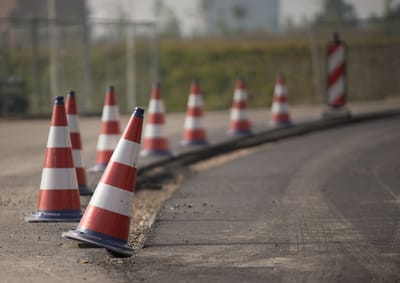
| Transition (taper) | Moves traffic out of the closed lane along a sloped taper. | Cones or delineators in a channelizing taper; an arrow board at the head of a lane closure |
| Activity area | The work space, plus a buffer protecting workers. | Type I/II/III barricades, with flashing barricade beacons for night work |
| Termination | Returns traffic to normal and signals the zone has ended. | End Road Work (G20-2) sign, downstream taper |
MUTCD Part 6 temporary traffic control — the four areas, in order of travel.
Roll-up vs rigid signs
Roll-up orange signs (fabric on a spring-steel frame) deploy and stow in seconds — ideal for short-duration and mobile operations. Rigid aluminum signs with reflective sheeting are the choice for long-term setups where a sign stands for days or weeks. Match sheeting grade to road speed (see the MUTCD sheeting guide).
Sizing the taper
The transition taper length scales with posted speed and lane width — faster roads need a longer, gentler taper so drivers can merge safely. Space channelizing devices evenly along it (a common spacing is roughly the speed limit in feet). For exact taper lengths and device spacing, follow your agency's TTC plan or the MUTCD tables for the work type.
Spec tip
Taper length isn't one-size-fits-all — a 45 mph lane closure needs a much longer taper (and more cones) than a 25 mph one. Send us the posted speed and lane width and we'll size the channelizing-device count for you.
The job-site kit
For a single-lane closure on a low-speed road, a typical order covers each area in turn:
- Advance warning — a set of roll-up W20-series signs (Road Work Ahead, Lane Closed Ahead, Flagger) with stands
- Flagging — a Stop/Slow paddle and hi-vis vest for every flagger
- Taper & buffer — cones or delineators (the count scales with posted speed — see above) and Type I/II/III barricades
- Night or multilane work — flashing barricade beacons on the barricades, and a trailer-mounted arrow board at the taper
Outfit the zone
- Work Zone & Construction Traffic Control — the full job-site hub
- Roll-Up Traffic Signs — short-term & mobile
- Cones & Delineators — channelizing devices
- Work Zone Signs — rigid signs & Type I/II/III barricades
- Message Boards & Arrow Boards — trailer-mounted, solar-powered
- Flashing Beacons — barricade beacon lights
- Sign Hardware, Posts & Blanks — mounting
Ordering a full setup? Ask for volume/pallet pricing with your sign list and quantities.