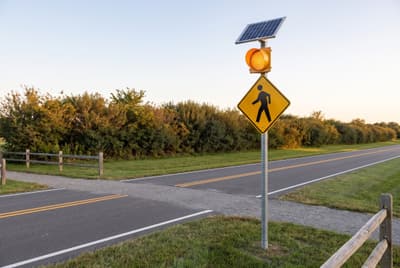
A solar flashing beacon is the simplest way to add active warning to a road: a bright amber or red LED light that flashes to grab a driver's attention, powered by its own solar panel and battery so there's no trenching, no electrician and no power bill. This guide walks the four families of flashing beacon we stock — from a $17 barricade light to a full push-button crosswalk system — plus how to size them, pick a color and flash pattern, and read the solar specs so the beacon still works after a cloudy week.
The four kinds of flashing beacon
"Flashing beacon" covers everything from a clip-on hazard strobe to an engineered crosswalk system. Start with the cheapest family that plausibly solves the problem — a warning beacon is an expensive way to do a barricade light's job, and a barricade light won't stop traffic at a crosswalk.
What are you warning about?
Reach for Solar warning beacons (8"/12") (≈$700–$1,700) — A round amber or red LED beacon on its own housing, solar-charged, flashing 24/7 or dusk-to-dawn to draw attention to a sign or hazard point. Shop it →
| Family | What it is | Catalog price band | Reach for it when |
|---|---|---|---|
| Barricade & hazard beacons | A small battery- or solar-powered strobe that clips to a barricade, cone or drum to mark a night-time hazard. | ≈$17–$55 | Temporary road-work, an open trench or a closed lane — cheap, portable warning you can deploy by the dozen. |
| Solar warning beacons (8"/12") | A round amber or red LED beacon on its own housing, solar-charged, flashing 24/7 or dusk-to-dawn to draw attention to a sign or hazard point. | ≈$700–$1,700 | Drivers roll past a static sign, curve, stop or intersection — the flash buys back the attention the sign is missing. |
| Beacon + sign kits | A flashing beacon pre-paired with a STOP, school-crossing or crosswalk sign — the regulatory panel and the flash as one assembly. | ≈$700–$1,940 | You need both the MUTCD sign and the flash, and want them speced and shipped together instead of assembled on site. |
| RRFB crosswalk systems | Rectangular Rapid-Flashing Beacons: a push button triggers a rapid wig-wag flash, with radio-synced units facing each approach. | ≈$1,250–$4,140 | An uncontrolled marked crosswalk where the flash should fire only when a pedestrian is actually waiting to cross. |
Price bands are catalog-wide, rounded, and span the single-to-double-head and system-size choices within each family — see each product page for live pricing. Where a device is allowed (RRFBs, in-street signs, flashing stop beacons) is set by the MUTCD and your state supplement — verify placement with your state or local traffic authority.
8″ vs 12″: sizing a warning beacon
Round solar warning beacons come in 8″ and 12″ lens diameters. Both are rated visible from more than 2,500 feet, but the 12″ throws a larger, more conspicuous signal — the rule of thumb is the same as sizing a sign: the faster and wider the road, and the longer the approach, the bigger you go. When sight distance is marginal, step up.
| Size | From (single head) | Best for |
|---|---|---|
| 8" | from $700 | Local & residential streets, parking lots, campuses and private roads — shorter sight lines, lower speeds. |
| 12" | from $900 | Higher-speed or wider roads, rural intersections and long approaches where you need the bigger, more conspicuous signal. |
Need to warn traffic from both directions at once? The double 8″ ($1,300) and double 12″ ($1,700) mount two beacon heads back-to-back on one battery box. Housing is a durability choice, not a price one: the standard ABS-shell 8″ and 12″ beacons and the tougher metal-housing versions sit at the same $700 / $900 price points.
Colors & flash patterns
Two things a beacon buyer specs after size are the LED color and how it flashes:
- Amber (yellow) — general caution and warning. This is the default for hazard, crossing and speed contexts.
- Red — stop and regulatory contexts. Pair a red beacon with a STOP sign or an all-way-stop approach.
How the beacon flashes is a spec line, not an afterthought:
- 24/7 flash — the standard round beacons flash continuously at ~50 flashes per minute, day and night.
- Dusk-to-dawn — an option on the standard and double-head beacons and the default on the solar barricade lights, so they run only after dark.
- Timer — school zones usually flash on a schedule; the beacon kits and school-zone flashers offer a timer.
- App-controlled — the Helios beacon line is Bluetooth-controlled through the "TT Solar" app (timer plus a uniform tinted lens with no visible LED dots).
- Push-button wig-wag — RRFB systems fire a rapid alternating flash for ~60 seconds when a pedestrian presses the button, then stop.
Our round beacons are built to MUTCD Type B high-intensity and follow the flashing-beacon design and operation rules in MUTCD Part 4 (§4L). Which beacon type is permitted at a given location — warning, stop, speed-limit or intersection-control — is set by the MUTCD and your state supplement, so confirm the application with your traffic authority.
Solar power & autonomy
Nearly every beacon here is solar by default, and the spec that matters most is how long it keeps flashing through cloudy weather. The standard 8″ and 12″ beacons pair a 15 W / 18 V panel with a 12 V / 7,200 mAh battery and run 5–7 consecutive days on a single full charge — sized so a run of overcast days won't go dark. The RRFB systems step up to an 18–20 W monocrystalline panel and a 12 V / 8,800 mAh lithium pack. The small barricade beacons carry an integrated panel and a compact lithium cell for dusk-to-dawn duty.
Because they're self-contained, all of them install anywhere the sun reaches — no AC run, no trenching. The trade-off is that a heavily shaded pole or a north-facing wall starves the panel, so site the solar panel where it gets real sun even if the beacon head faces the road.
RRFB crosswalk systems
A Rectangular Rapid-Flashing Beacon (RRFB) is the highest tier of flashing beacon: a pedestrian presses a push button, and a pair of rectangular LED bars fires a rapid, irregular wig-wag flash that's far more attention-grabbing than a round beacon — then shuts off about 60 seconds later. The units talk to each other over a radio link so both sides of the crossing flash in sync. They come as a single beacon ($1,250), a two-post system ($2,500), and a back-to-back system ($3,500) for medians and multi-approach crossings. Each ships with the beacon, control box, solar panel, push button and mounting hardware — the pole and any warning sign are ordered separately.
RRFB placement and use are governed by the MUTCD and your state supplement — verify the crossing warrants an RRFB with your local traffic engineer before you spec one.
Spec tip
A mid-block crosswalk usually needs to warn both approaches — use a double-head beacon or a back-to-back RRFB rather than pricing two single units and missing the shared controller and radio sync. Send us the crossing count, posted speed and whether the panel can see the sun, and we'll config the system for you.
Common questions
Do solar flashing beacons keep working on cloudy days?
Yes — the battery is sized for it. The standard 8″/12″ beacons hold a 12 V / 7,200 mAh charge and flash for 5–7 days without any new sun, so a normal run of overcast days won't drain them. Give the panel a spot with real daylight and it tops the battery back up between storms.
Should I buy an 8″ or a 12″ beacon?
Go by road speed and sight distance. An 8″ beacon is right for low-speed local streets, lots and campuses; step up to 12″ for faster or wider roads and longer approaches where you want the larger, more conspicuous signal.
Amber or red?
Amber (yellow) is for general warning and caution — the usual choice at crossings, curves and hazards. Red is for stop and regulatory contexts and pairs with a STOP sign or an all-way-stop approach.
What's the difference between a warning beacon and an RRFB?
A round warning beacon flashes continuously to flag a hazard or sign. An RRFB is a pedestrian-actuated crosswalk system — it stays dark until someone presses the button, then fires a rapid wig-wag flash to stop traffic on demand.
Do beacons include a pole or a sign?
Standalone beacons and RRFB systems don't include the pole (and RRFBs don't include the warning sign) — they ship with mounting hardware for a standard round post. The beacon + sign kits do include the MUTCD sign paired with the beacon; the mounting post is still ordered separately.
Shop flashing beacons
- Flashing Beacons — the full range: 8″/12″ warning beacons, kits & RRFBs
- 8″ Solar LED Warning Beacon — amber or red, $700
- 12″ Solar LED Warning Beacon — the higher-speed size, $900
- RRFB Crosswalk System — push-button, radio-synced pair
- Solar Barricade Beacon Light — clip-on work-zone hazard strobe, $55
- Solar Flashing Safety Signs — the whole self-powered active-warning line
- Helios Series — app-controlled, uniform-lens beacons & signs
Building out a corridor, campus or district? See the companion guide to choosing solar flashing, school-zone & radar speed signs for the full escalation ladder, and the MUTCD sign compliance guide for sizes and sheeting. Ready for a quote? Contact us with your locations, quantities and power situation.