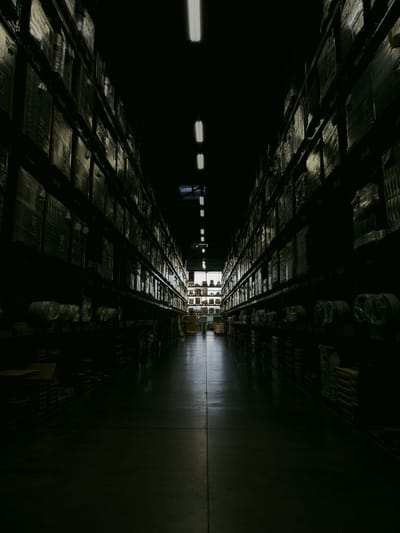
In a warehouse or shop, the fixture wattage you need is driven mostly by how high it's mounted — light spreads and dims with distance. Here's how to match a high-bay to your ceiling, task and aisle layout.
Wattage by ceiling height
At 20 ft, spec a 200–240 W high-bay — ~23,000–31,200 lm. Typical for distribution, manufacturing. Shop high-bays →
| Mounting height | Typical fixture | Output | Where |
|---|---|---|---|
| 12–15 ft (low bay) | 100 W | ~12,000–13,000 lm | Retail, small shops |
| 15–20 ft | 150 W | ~18,000–19,500 lm | General warehouse |
| 20–30 ft | 200–240 W | ~23,000–31,200 lm | Distribution, manufacturing |
| 30 ft + | 300 W | our highest output | Tall racking, hangars — tighten fixture spacing or ask us for a layout |
Light level by task
Target footcandles by what happens below: ~10–20 fc for bulk storage and aisles, ~30–50 fc for assembly, packing and inspection, and more for fine detail work. Spacing the fixtures for uniformity matters as much as raw lumens — shadows between racks are a safety issue.
UFO high-bays and beam angle
We stock UFO round high-bays from 60 W to 300 W — compact fixtures ideal for open floors and point coverage. Match the beam angle to the space: a narrower beam for tall or narrow aisles, a wider beam for low, open rooms. Use 4000–5000K for warehouse work. If your racking layout calls for linear high-bays over narrow aisles, we don't stock them — contact us and we'll quote them for the project.
Replacing metal halide or HPS?
If your inventory reads in HID watts — “forty 400 W metal-halide fixtures” — translate to LED first, then sanity-check against the ceiling-height table above. And count the true draw, not the lamp rating: a magnetic ballast adds roughly 10–15%, so a 400 W metal halide actually pulls ≈455 W at the meter. Typical swaps:
| Existing fixture (MH / HPS) | True draw with ballast | LED replacement |
|---|---|---|
| 250 W | ≈290 W | ~100 W high-bay |
| 400 W | ≈455 W | 150 W–200 W high-bay |
| 1,000 W | ≈1,080 W | ~300 W high-bay |
The math for the CFO, one fixture at a time: swap a 400 W metal halide (≈455 W true draw) for a 200 W UFO high-bay and you cut ≈255 W. Assuming 12 hours a day at $0.12/kWh, that's 255 W × 4,380 h ≈ 1,117 kWh — about $134 per fixture per year, so a 40-fixture floor saves ≈$5,360 a year on energy alone. Then add relamping: the stocked UFO line is rated to 50,000 hours — 11+ years at that duty cycle — where MH lamps dim early and need a lamp-and-lift visit every few years. Different hours or rate? Scale it: watts saved × annual hours ÷ 1,000 × your $/kWh.
Draw and savings figures are estimates — ballast losses vary by gear, and your utility rate decides the payback. Send us your fixture schedule and we'll run the numbers per fixture, LED wattage included.
Rebate tip
Many utilities pay rebates on high-efficacy LED high-bays — often enough to offset a chunk of the order. Send us your ceiling height and floor plan and we'll spec the fixtures and check rebate eligibility with your utility before you order.
Shop high-bays
- Warehouse & Industrial High-Bay Lighting — the hub
- Commercial LED High Bay — UFO high-bays, 60–300 W
- Selectable / Tunable CCT — one SKU, set the color on site
Lighting the parking lot outside too? Size exterior fixtures with our parking-lot lighting: wattage, lumens & pole spacing guide.
Send us your ceiling height and floor plan for a free fixture count and rebate estimate — contact us.